10 Powerful Chicken Soup for the Soul Sayings to Guide Your Life

Introduction
There is a specific kind of comfort found in the Chicken Soup for the Soul philosophy—a sense that even in our most fragmented moments, there is a cohesive pattern to our growth. These aren’t merely words of empty optimism; they are gentle reminders of the architecture of the human experience. This collection explores the profound wisdom found within these teachings, moving beyond simple sentiment to examine how we learn, how we perceive, and how we ultimately find our way back to ourselves.
The Classroom of Existence
Life is often experienced as a series of unpredictable events, but these reflections suggest a more intentional structure: we are permanent students in an informal, lifelong school. To embrace this perspective is to view every challenge not as a setback, but as a necessary curriculum for the soul.
“1. You will receive a body. You may like it or hate it, but it will be yours for the entire period of this time around. 2. You will learn lessons. You are enrolled in a full-time informal school called Life. Each day in this school you will have the opportunity to learn lessons. You may like the lessons or think them irrelevant and stupid. 3. There are no mistakes, only lessons. Growth is a process of trial and error: Experimentation. The “failed” experiments are as much a part of the process as the experiment that ultimately “works.” 4. A lesson is repeated until learned. A lesson will be presented to you in various forms until you have learned it. When you have learned it, you can then go on to the next lesson. 5. Learning lessons does not end. There is no part of life that does not contain its lessons. If you are alive, there are lessons to be learned.” — Chérie Carter-Scott
The Art of Presence
We often spend our lives chasing a distant “better” version of reality, believing that peace lies just over the next horizon. These insights challenge the habit of deferred living, urging us to recognize that the destination is a moving target and the only true reality is the one we currently inhabit.
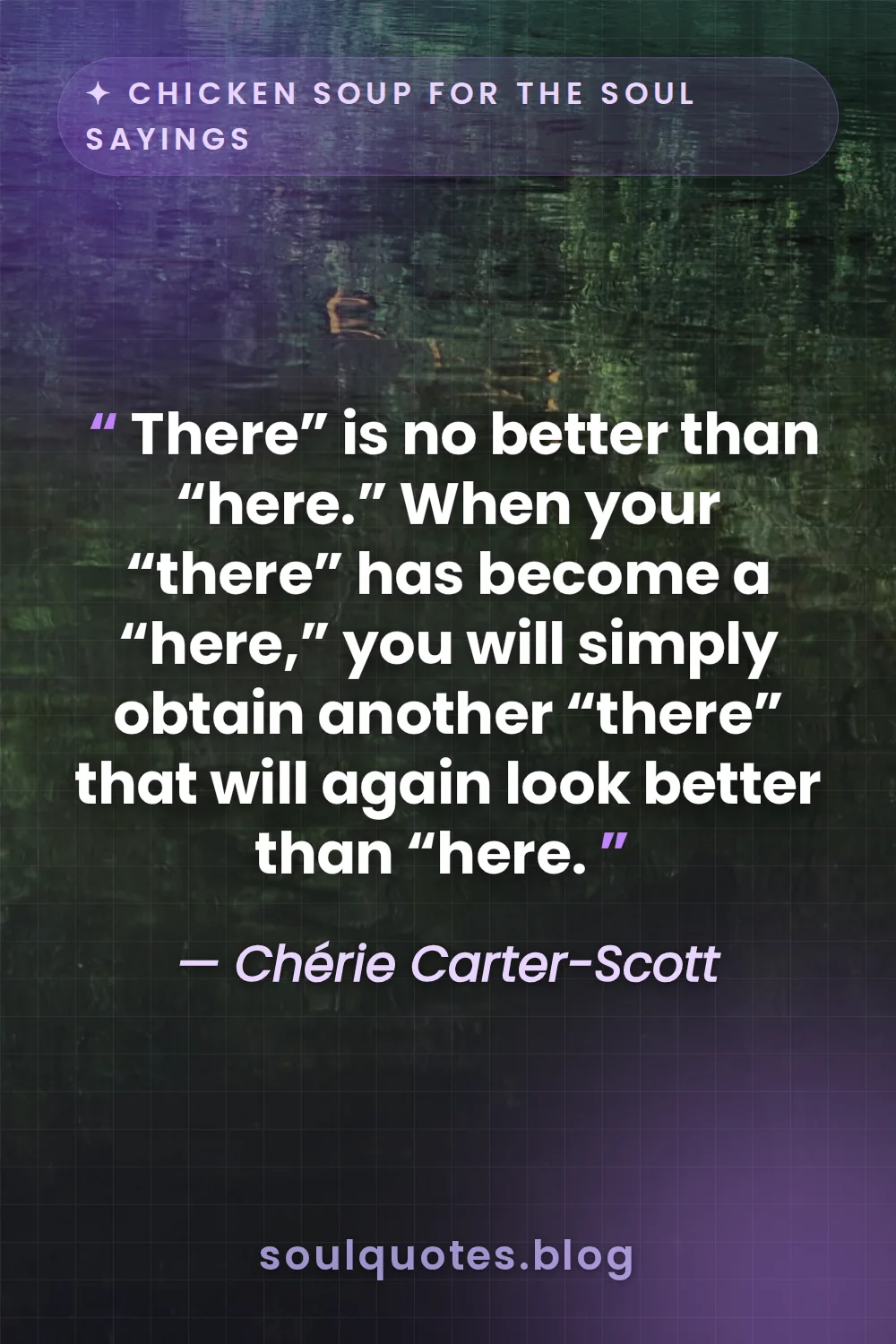
““There” is no better than “here.” When your “there” has become a “here,” you will simply obtain another “there” that will again look better than “here.”” — Chérie Carter-Scott
The Internal Compass
True agency and clarity do not come from external validation or the pursuit of worldly answers, but from a deep, quiet turning inward. By recognizing that our struggles and our strengths are reflections of our own inner state, we reclaim the power to shape our own lives.
“7. Others are merely mirrors of you. You cannot love or hate something about another person unless it reflects something you love or hate about yourself. 8. What you make of your life is up to you. You have all the tools and resources you need. What you do with them is up to you. The choice is yours. 9. Your answers lie inside you. The answers to Life’s questions lie inside you. All you need to do is look, listen and trust. 10. You will forget all this.” — Chérie Carter-Scott
Understanding the Wisdom
Readers often seek to understand the deeper meaning behind these Chicken Soup for the Soul sayings. Whether you are looking for short, impactful truths or a deeper summary of this life philosophy, the core message remains consistent: life is a continuous cycle of reflection and evolution.
Common inquiries regarding these teachings:
- What is the meaning of Chicken Soup for the Soul sayings? At their core, these sayings focus on emotional healing, resilience, and the recognition of the sacred in everyday human experiences.
- Are there short Chicken Soup for the Soul sayings for daily inspiration? Yes, many of these reflections, such as the concept that “there is no better than here,” serve as concise mantras for mindfulness.
- What is the overall summary of this wisdom? The overarching theme is that life is a purposeful journey of learning, where every person possesses the internal tools necessary to navigate their own growth.
A Final Reflection
To engage with these quotes is to accept a certain level of accountability for one’s own journey. They suggest that while we cannot control the lessons life presents, we have absolute authority over how we learn from them. Use these words not just as fleeting inspiration, but as anchors to return to when the world feels loud and the path ahead feels uncertain.
Explore more: [Good Morning Messages for Him: 65 Sweet, Flirty and Romantic](https://greetingsandquotes.live/quotes & sayings/good-morning-messages-for-love-him/)
Related Articles