Powerful Quotes on Divided We Fall and the Strength of Unity

The Fragility of Cohesion: Reflections on Unity and Division
The adage “United we stand, divided we fall” serves as more than a mere political slogan; it is a fundamental observation of the human condition and the structural integrity of any collective endeavor. Whether applied to a family, a community, or a nation, the principle suggests that our strength is not found in our individual capacities, but in the quality of the bonds between us. This collection explores the profound warnings inherent in fragmentation and the enduring necessity of social and spiritual cohesion.
In the following curated selections, we move beyond the surface of the phrase to examine the historical, spiritual, and civic weight behind the concept of unity. Through these words, we find a roadmap for understanding why division is so destructive and how the power of collective action remains our only safeguard against desolation.
The Ancient Wisdom of the Divided House
Long before modern political discourse, spiritual and foundational texts recognized that division is a self-destruct mechanism. These quotes highlight a universal truth: any structure, whether a physical building or a social order, cannot survive when its internal components work against one another.
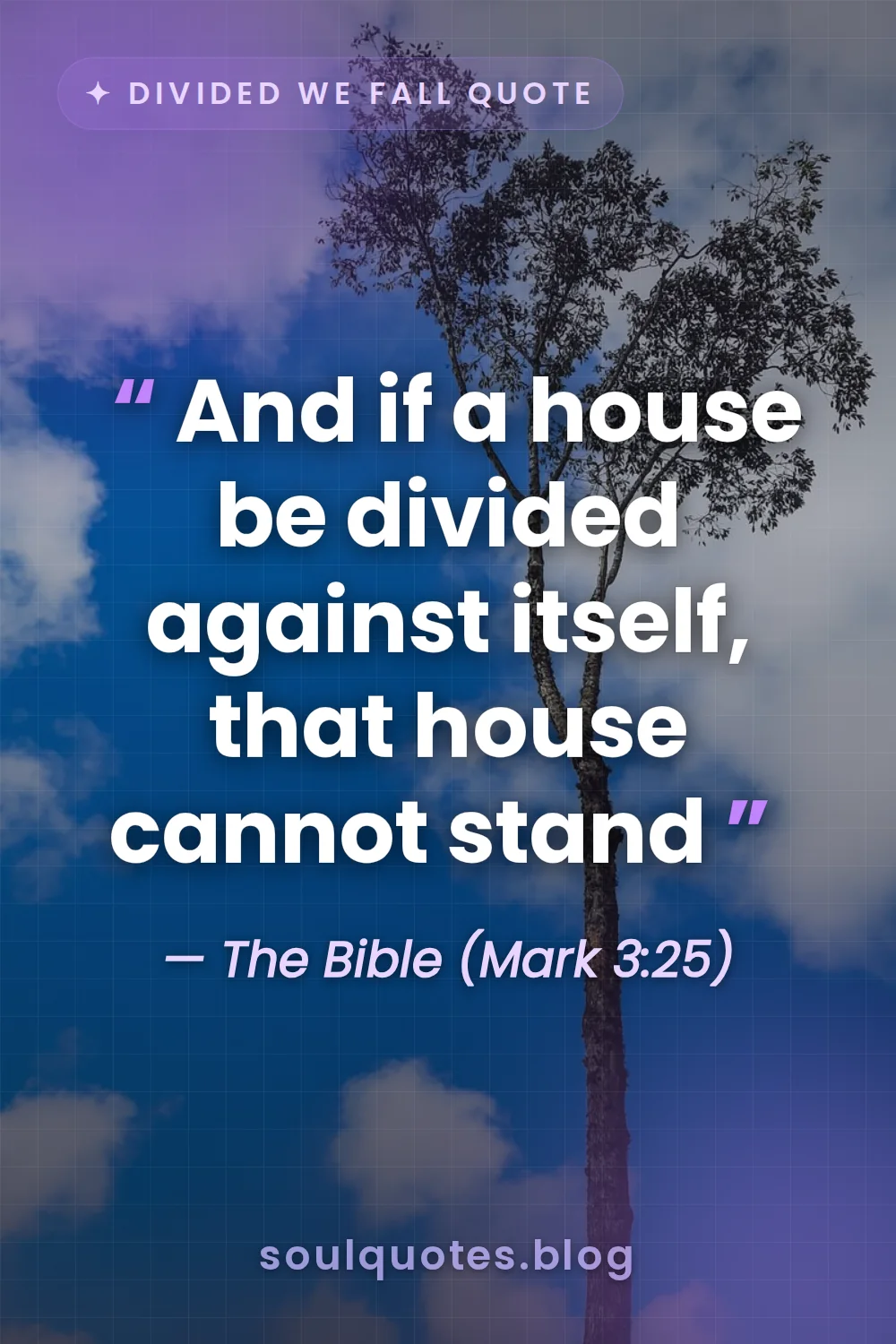
“And if a house be divided against itself, that house cannot stand” — The Bible (Mark 3:25)
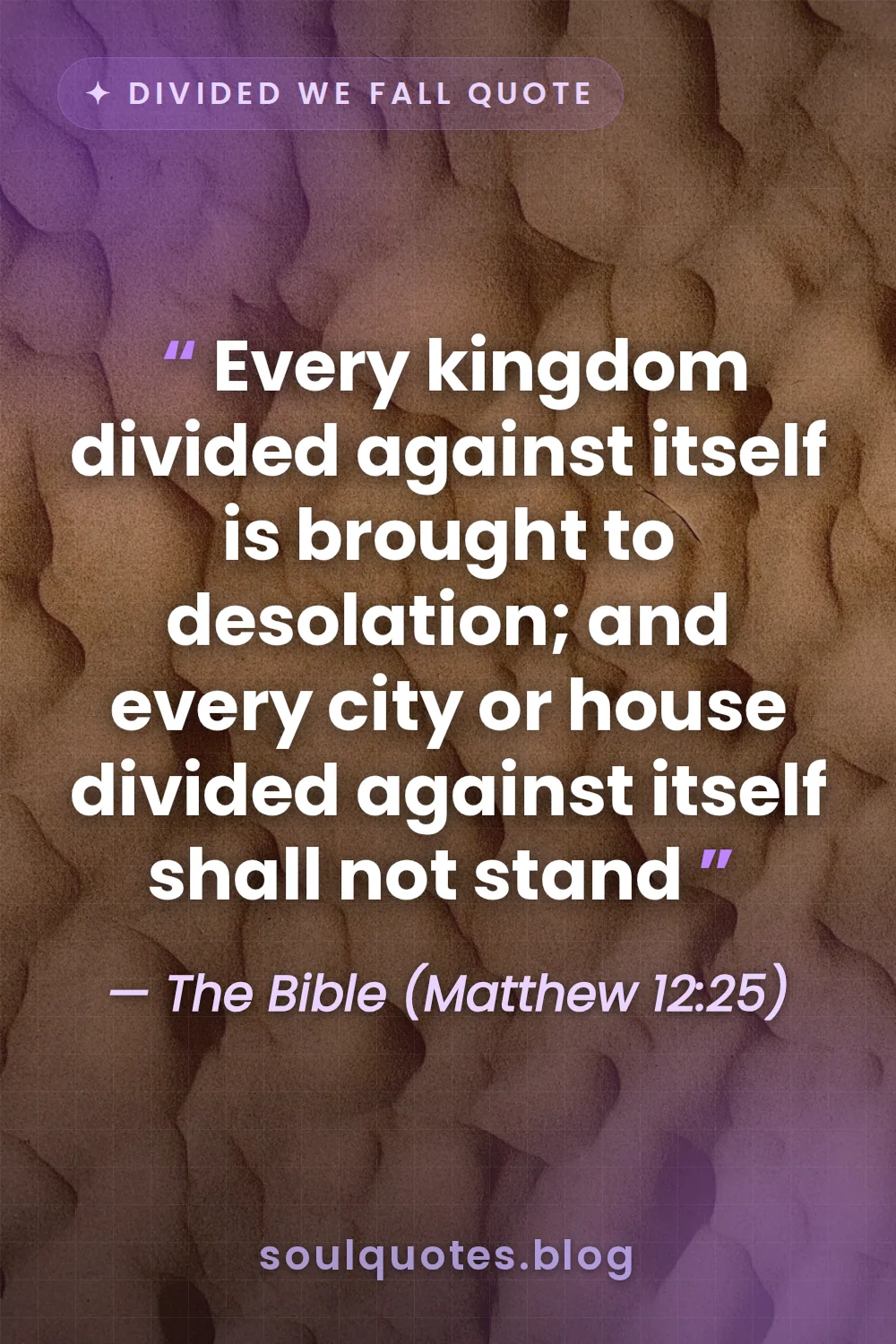
“Every kingdom divided against itself is brought to desolation; and every city or house divided against itself shall not stand” — The Bible (Matthew 12:25)
“Every kingdom divided against itself is brought to desolation; and a house divided against a house falleth” — The Bible (Luke 11:17)
“United we stand, divided we fall” — Aesop (attributed)
Foundational Warnings for the Body Politic
As societies grow in complexity, the threat of factionalism becomes more subtle and pervasive. These reflections from statesmen and thinkers warn us that the loss of shared purpose is often the precursor to a total collapse of the systems we rely upon.
“A house divided against itself cannot stand.” — Abraham Lincoln
“Let us not split into factions which must destroy that union upon which our existence hangs.” — Patrick Henry
“Then join hand in hand, brave Americans all! By uniting we stand, by dividing we fall!” — John Dickinson
“The name warns of the consequences of division.” — Joseph Schuman
The Modern Crisis of Fragmentation
In our contemporary era, the forces pulling us apart often feel more powerful than those drawing us together. This section addresses the specific, modern anxieties regarding cultural and social erosion, noting that unity is not a permanent guarantee but a constant work in progress.
“The continued unity of the United States of America cannot be guaranteed. At this moment in history, there is not a single important cultural, religious, political, or social force that is pulling Americans together more than it is pushing us apart. We cannot assume that a continent-sized, multi-ethnic, multi-faith democracy can remain united forever, and it will not remain united if our political class cannot and will not adapt to an increasingly diverse and divided American public.” — David French
The Agency of the Collective
While the warnings of division are stark, they are balanced by a profound sense of agency. These quotes remind us that the “divided we fall” sentiment is not a prophecy of inevitable doom, but a call to responsibility—affirming that we possess the power to restore what has been fractured.
“We the People have the power to form a more perfect Union. We the People have the power to demand change. To demand compromise. We the People have the power to restore of the great tradition of American bipartisanship.” — Joseph Schuman
“We believe that divided we fall, but united we stand.” — Joseph Schuman
“If we do not do our duty as citizens, we get what we deserve: bad government.” — Harry Truman
Understanding the Concept
Many readers seek to understand the specific origins and meanings of this concept. Below is a brief guide to common questions regarding this timeless principle.
Frequently Asked Questions
- What is the saying about divided we fall? The full sentiment is most commonly expressed as “United we stand, divided we fall.” It signifies that a group’s strength is derived from its unity, and its vulnerability arises from its internal conflicts.
- What is the origin of the phrase? While often attributed to Aesop, the concept appears in various forms throughout history, including the writings of Robert Grosseteste in the 13th century and as a central theme in American revolutionary rhetoric.
- Is there a Bible verse about being divided? Yes, several passages in the Gospels (Mark 3:25, Matthew 12:25, and Luke 11:17) use the metaphor of a divided house to illustrate that internal conflict leads to destruction.
To reflect on these quotes is to acknowledge that unity is a fragile, precious thing. They serve as a reminder that the strength of our houses, our communities, and our nations depends entirely on our willingness to bridge the gaps between us.
Frequently Asked Questions
What is the saying about divided we fall?
The full sentiment is most commonly expressed as United we stand, divided we fall. It signifies that a groups strength is derived from its unity, while its vulnerability arises from internal conflicts.
Related Articles